Research
In my dissertation, I discussed how to “Combine Network Research and Computational Methods on Historical Research Questions and its Implications for the Digital Humanities”, reflecting on the genesis of the digital humanities (DH) and social and historical network research (SNR and HNR), the theorization and impact of DH, as well as the requirements of a multimodal literacy incorporating digital and computational competences, algorithm and tool criticism, and the changed epistemologies of working with the digital. There, I proposed modeling as the underlying epistemological framework. With the framework of modeling, my thesis reconceptualizesd computational methodologies for historical research questions and identified modeling as an inherent concept within the historical studies, i.e. the historical narrative as a best-fit model to explain the how and why of history and periodization as models of time-scales as a construct of analysis to sharpen focus, and the use of networks as epistemic tools. In my dissertation, I evaluated the limitations and implications of its epistemological and ontological changes based on two case studies: on the extent of political judiciary in the Austrian “Corporate State”, and on the structural analysis of influence networks of intellectuals.
An overview of my publications is recorded at 0000-0002-6178-7332.
Analysing network structures of political judiciary
Tags: Network Research, Cluster Analysis, Structural Analysis, Statistics, Data Analysis
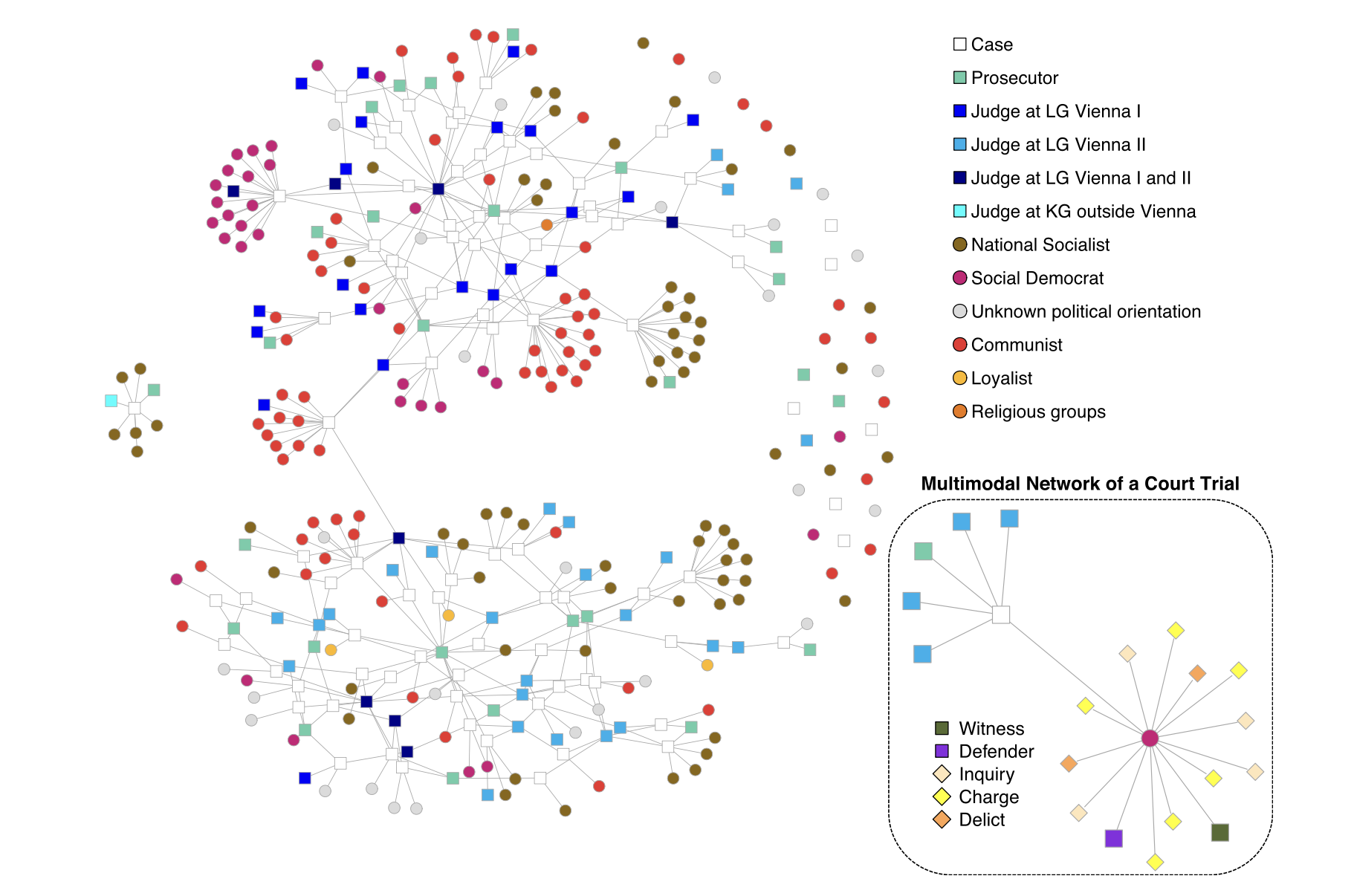
In “Configuration to Conviction. Network structures of political judiciary in the Austrian Corporate State”, I conceptionalized court records as networks (compare to Figure 1), which allowed me to analyze them structurally. Goal of the analysis was to investigate the extent of political judiciary in the transformed system of the so-called “Corporate State” of Austria. I evaluated differences in the legal prosecution of the political opposition based on over 1800 court trials from 1935 processed at the Viennese provincial courts.
Every subsequent analysis I did in R and R-Studio at first, and then fully switched to Python, which allows object-based programming and version-control via Anaconda and GitHub.
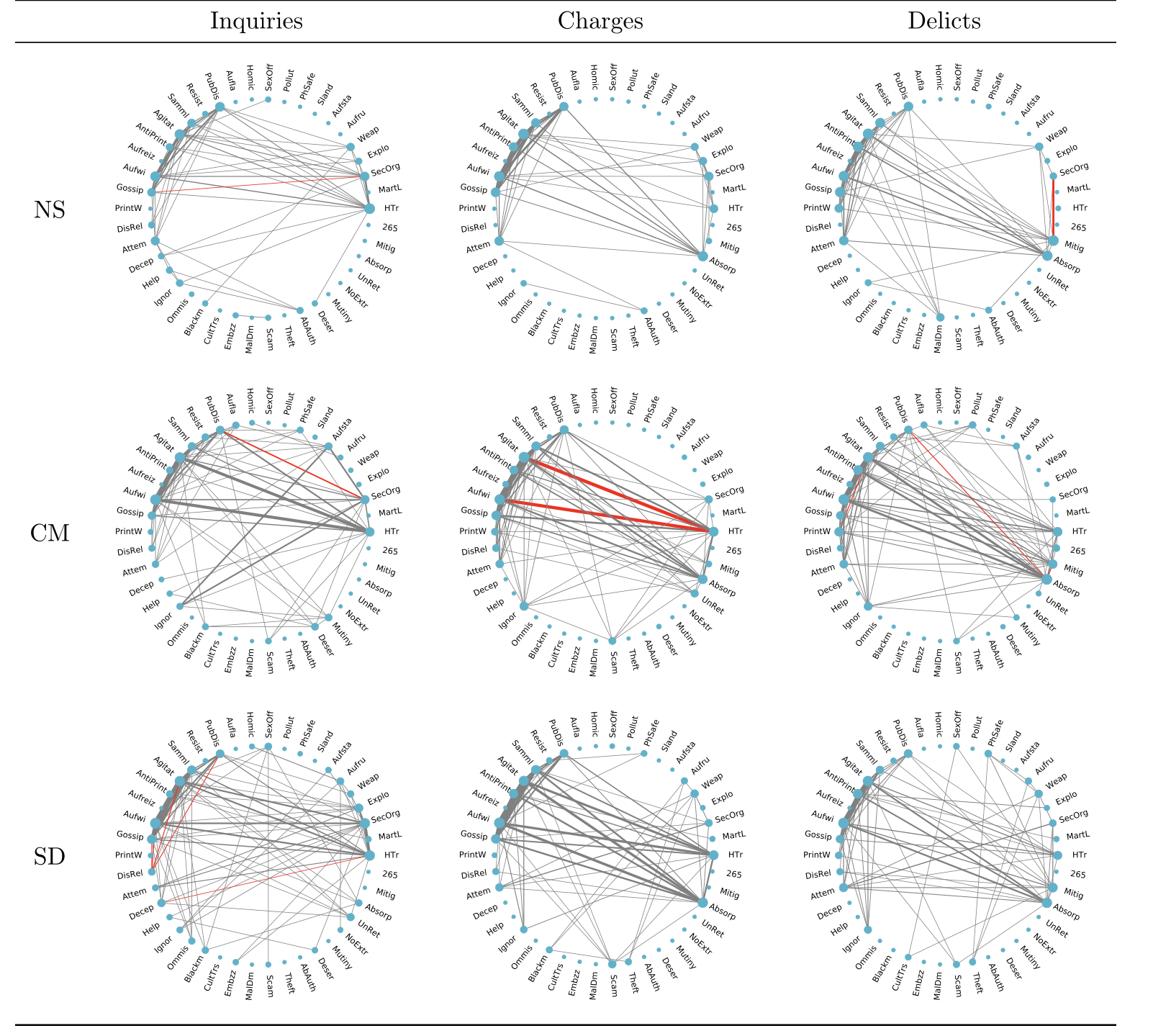
Combining a formalized network methodology and a quantitative assessment of frequencies and distributions with a qualitative contextualization, I could show different practices of political judiciary at court and specialized strategies to prosecute the political opposition, resulting in a clear bias against left-wing groups and a relative leniency in the conviction of National Socialists based on the evolution of charges in the courts’ actions (compare to Figure 2).
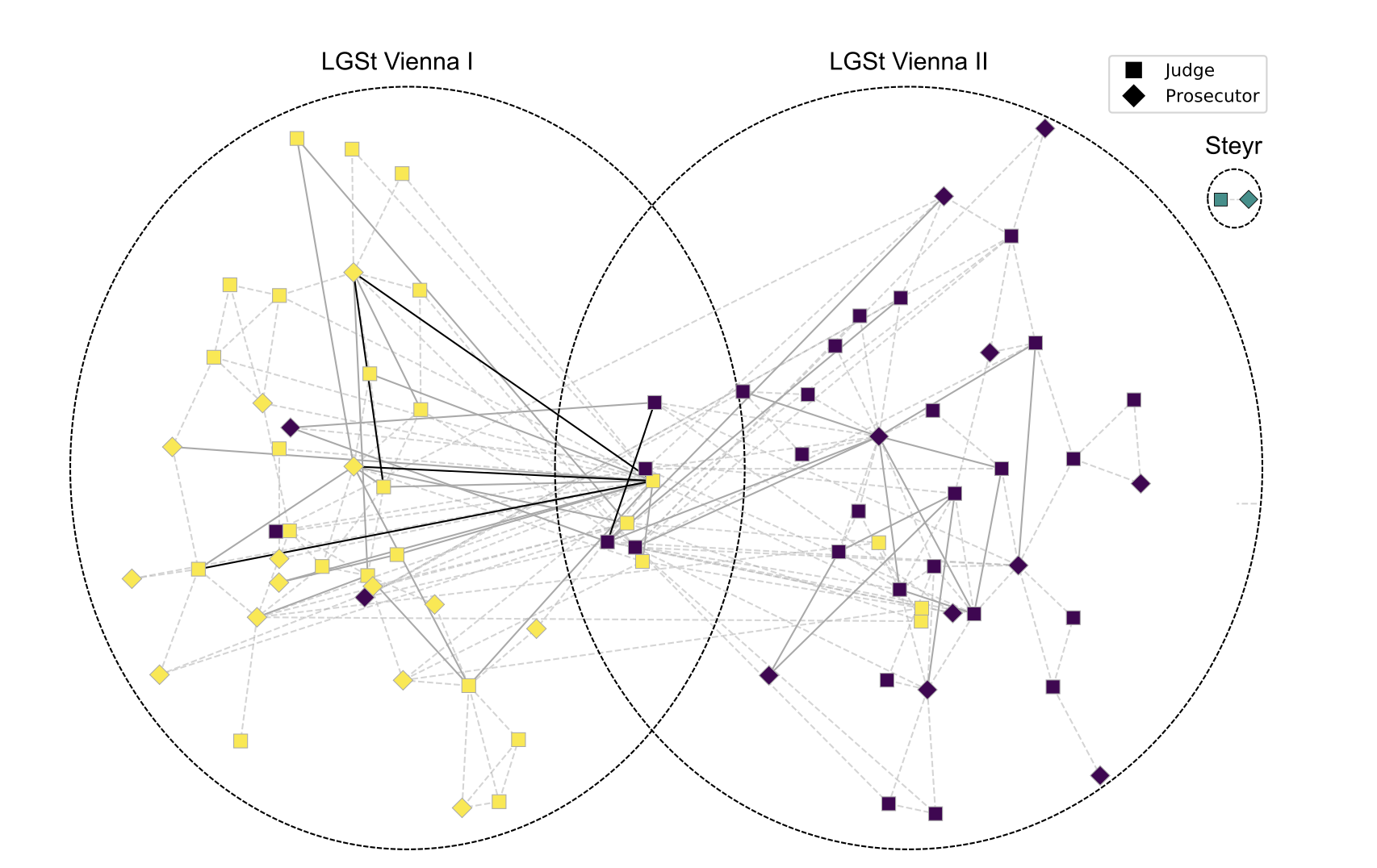
A multimodal network approach combining statistics, a spectral cluster analysis (Figure 3) and structural analysis, revealed key players and cooperation of judges and prosecutors which accounted for harsher sentences.
Finally, in the paper I argue that the system of control over the judiciary and over the political opposition was already crumbling in the Austrian capital in 1935, even before the ’’Anschluss” to NS-Germany in 1938. For the full paper, follow this link.
Construction of political criminality
Tags: NLP, Text Mining, Data Analysis, Statistics, OCR, Machine Learning, LLMs
My current Habilitation project at Leibniz Institute of European History extends on my previous work, and examines the various constructions of political criminality at court during the Dollfuß-/Schuschnigg-Regime (1933/34–1938) in order to trace the transformation of the former Austrian democracy to an autocracy. I am examining e.g., linguistic strategies towards Social Democratic, Communist, and National Socialist suspects in the statements of police, prosecutors, and judges within the court proceedings. Questions of political and political-confessional marginalisation and (acceptable) deviancy at court will be of particular interest.
Situated at the interdisciplinary crosspoint of computational history, legal history, and computer linguistics, in this project I am combining historical contextualization with methods from Natural Language Processing, Text and Data Mining methods, utilizing un-/supervised Machine Learning, and LLM-assisted information extraction and argument mining in Python to analyse court records from the 1930s.
This work is currently under progress.
A DH framework for the history of intellectuals
Tags: Network Research, Structural Analysis, Statistics, Community Detection, Centralities, Knowledge Brokerage, Temporal Analysis, Life-Cycle Events, Diffusion
In this joint project with my colleague Dr. Raji Ghawi, we studied a big Linked Open Data set of influence relations between intellectuals, which we extracted from YAGO via an SQL query.
We contrued the history of intellectuals as a long-spanning entangled web of influences, interdependencies, and inspirations by means of a formalized network approach, which we analyzed in Python and Jupyter Notebooks.
In “Analysis of a Social Network of Intellectual Influence”, we proposed such a approach, and operationalized the importance of scholars based on their structural position (i.a., centralities) in the influence networks.
In “A Longitudinal Analysis of a Social Network of Intellectual Influence”, we introduced a longitudinal perspective on the hitherto static networks, and studied the time-scliced network projections. This allowed us to re-evaluate, which scholars were most influential based on their structural position, such as centralities and knowledge-brokerage roles (e.g., Figure 4).
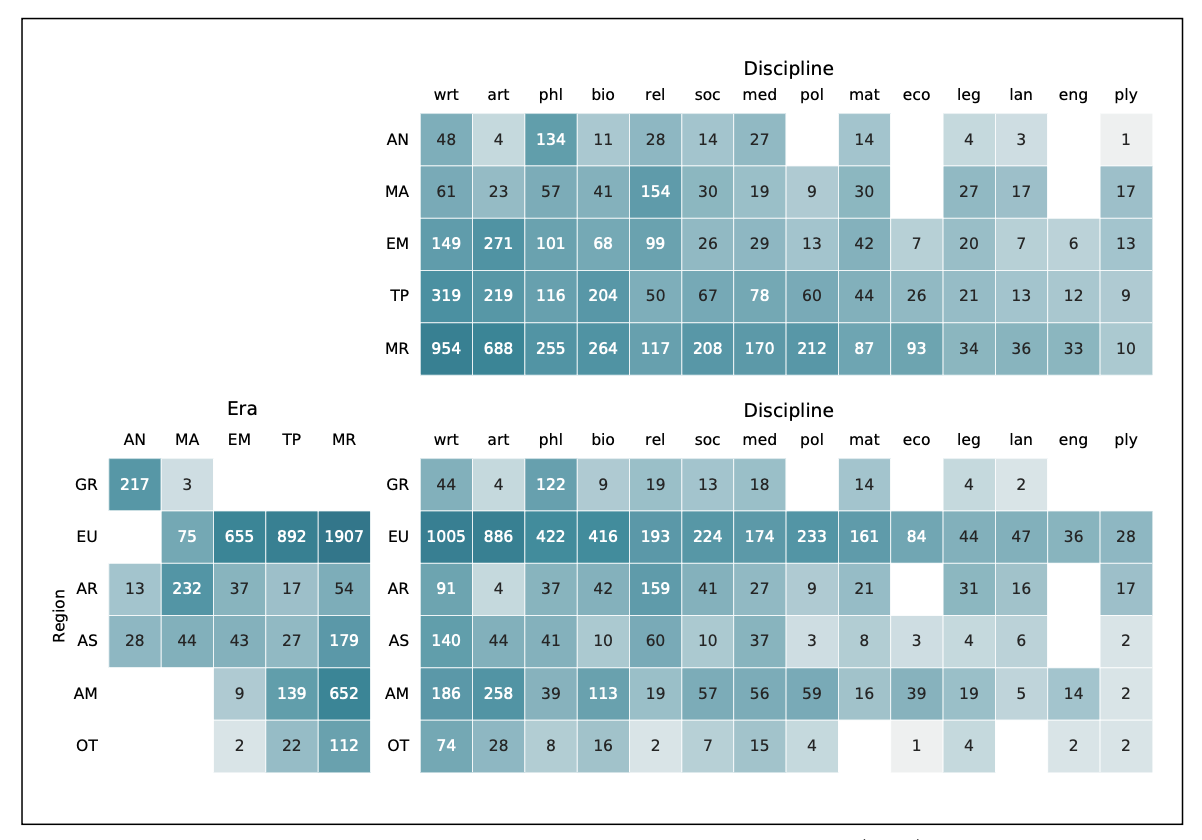
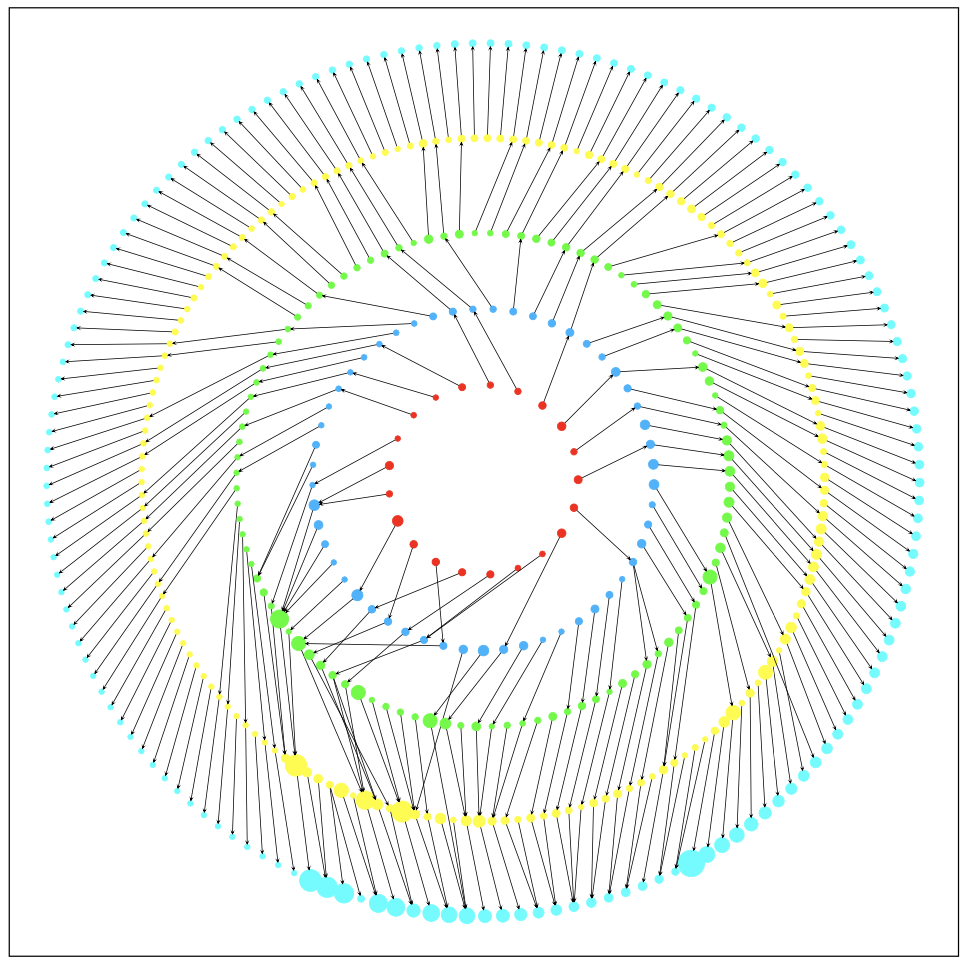
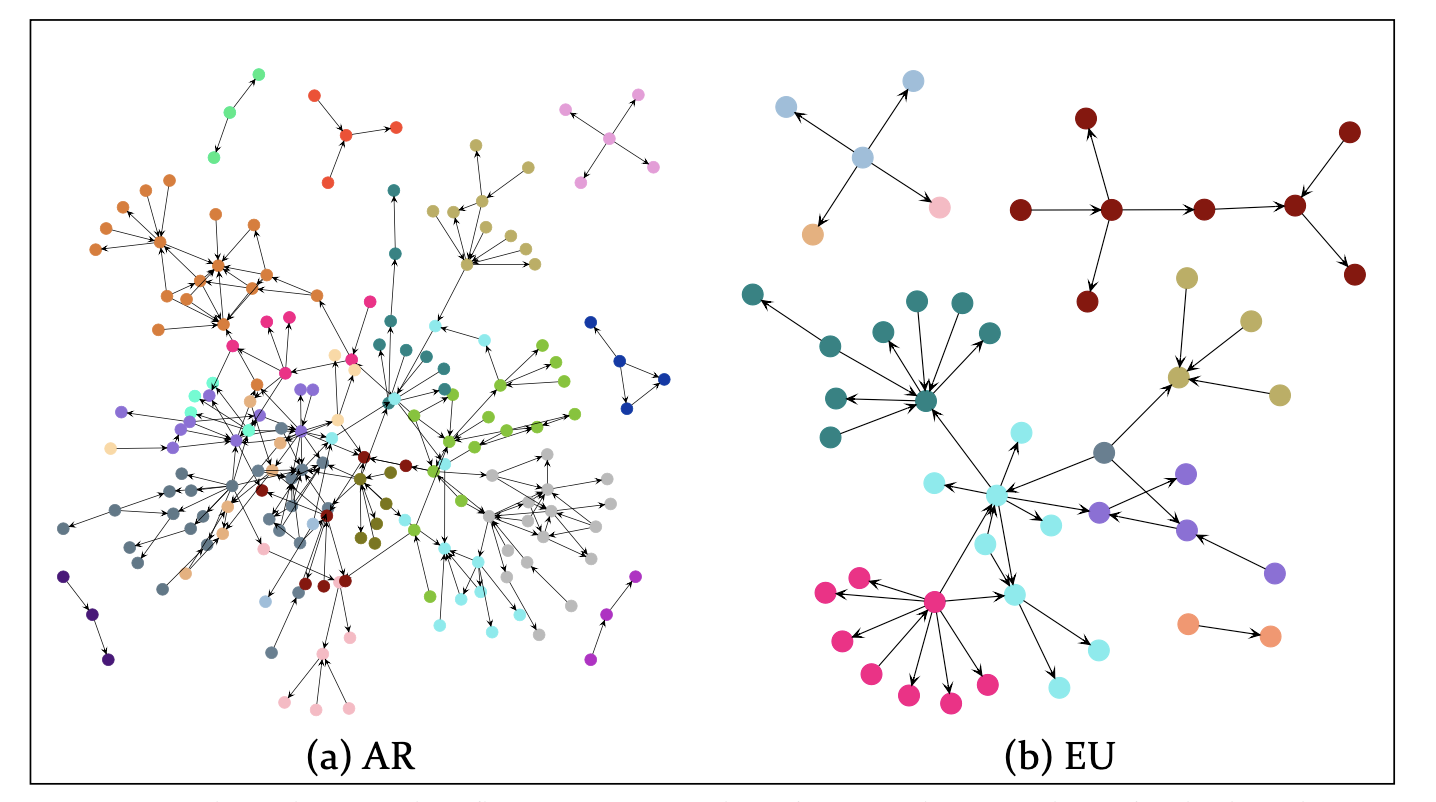
In “Tracking the Evolution of Communities in a Social Network of Intellectual Influences”, we aimed to identify schools of thought in these intellectual networks by detecting communities, and thus structurally analyzed and evaluated how these communities formed and developed in time, tracking their compositon and characterized the structural patterns of their dynamic evolution (e.g., Figure 5). We contextualized the changes in selected network structures in order to establish the merit of this method for a new perspective on the history of intellectuals, their influences, and their ideas (e.g., Figure 6).
Green DH and sustainability
Tags: Green DH, RDM, reusability, sustainability, legal personhood, LLM
I am interested in the field of Green DH, the impact of DH and adjacent developments in computational methods (such as LLMs; “Thirsty AI”) on resource overconsumption, questions of sustainability, and of reusability of research data. In this blogpost, I outlined some of its ramifications: increasing overconsumption in all aspects; water distribution problems while at the same time thirsty new technolgies become widespread and the contribution of the DH as part of digitization and digitalization efforts impact on the world’s carbon footprint and water consumption; the need for countermeasures, such as protecting natural resources with legal personhood status – or scaling sustainability from a structural level just as when the DFG made a research data management plan requisite for funding new projects.